
On a wall near the entrance of a classroom, there is a panel that invites us to pause on our way in.
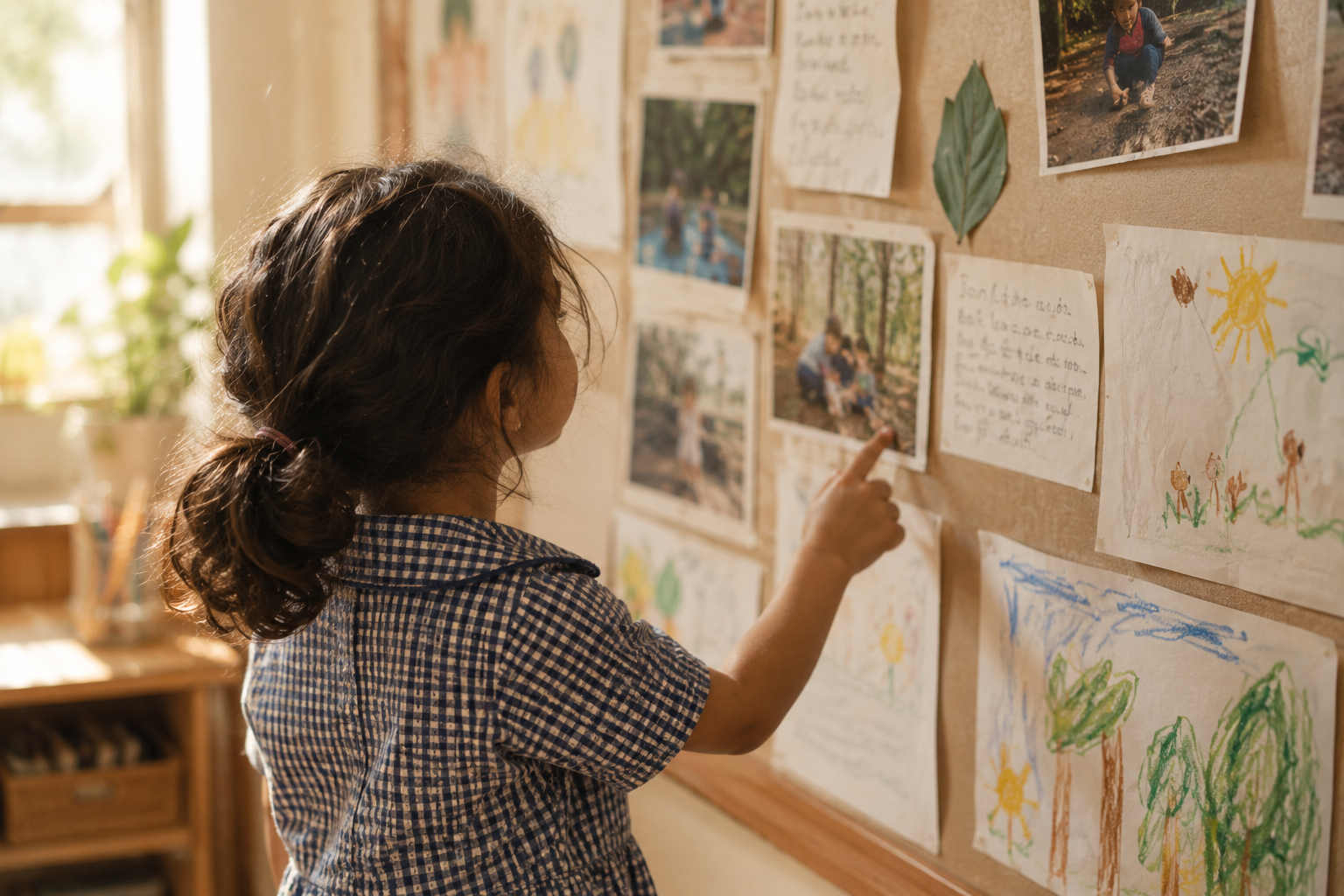
It begins with a photograph: four children crouched around a large sheet of paper on the floor, one child pointing at something the others cannot yet see. Beside it, in the teacher’s handwriting: “Kabir said the shadow is part of you. Priya said it isn’t, because you can’t feel it. We stopped in the morning to find out what was right, and find out more.”
Below are working drawings: shadows sketched at different times of day, arrows marking where the sun was, question marks, crossings-out, revisions. Fragments of transcribed conversation, including this exchange: “If it’s part of you, why does it disappear at night?” “Because you disappear too. You go to sleep.” “But the shadow goes before you do. I checked.”
At the bottom, the teacher has written a short paragraph, not a summary of what the children learned, but a reflection on what their questions revealed about how they were thinking, and where the inquiry might go next.
This is pedagogical documentation. It is not merely a beautiful display. It is not a certificate of achievement. It is a record of minds at work, made visible so that children and teachers can return to it, can learn from it, and parents can step into their child’s intellectual life rather than simply receiving a report about it.
Why visibility matters
Most of what is significant in a child’s learning is invisible to the naked eye. It consists of the moment a connection is made. The persistence through confusion. The courage it takes to revise a theory you were certain about yesterday.
Conventional school reporting tells us what a child produced and what they were able to accomplish. It rarely tells us how they thought, what they struggled with, or what they are in the process of becoming. It is, at best, a photograph of the destination with little about the journey.
John Hattie’s Visible Learning project, the largest synthesis of educational research ever conducted, drawing on over 800 meta-analyses, identifies the highest-impact influences on learning as consistently those that make thinking visible: teacher clarity, feedback, and students who can monitor their own understanding. When students are supported to predict their own performance and reflect on the gap between prediction and reality, the effect is the largest Hattie identifies in his entire dataset. Making learning visible to oneself is, it turns out, among the most powerful things a school can do.
The thinking behind our approach
The Reggio Emilia approach was born in northern Italy after the Second World War. Parents and educators, having witnessed what happens when people are taught not to think for themselves, made a deliberate decision: to build schools where children were treated as capable, curious, and full of rights.
At the heart of this philosophy is a claim about children: they are not empty vessels waiting to be filled, but active researchers of the world who arrive with their own theories and their own ways of making meaning. The educator Loris Malaguzzi expressed this through the idea of the hundred languages: children think and communicate not only through words, but through drawing, building, movement, music, and dramatic play. A school that privileges only writing and number silences most of what a child actually knows.
Central to this practice is pedagogical documentation: the pedagogy of listening, systematic observation, recording, and interpretation of children’s learning processes. Carlina Rinaldi, the foremost living theorist of the Reggio approach, describes documentation as serving three simultaneous purposes. It makes learning visible to the child, enabling them to revisit and deepen their own thinking. It makes learning visible to the teacher, giving them the evidence they need to plan precisely. And it makes learning visible to families, inviting parents into genuine intellectual partnership rather than the superficial engagement of newsletters and notice boards.
The convergence between Hattie’s research and Reggio Emilia is not accidental. Both insist that learning must be made conscious, shared, and revisable. Both place the learner’s own understanding of their learning at the centre.
What this looks like in practice
Teachers construct documentation panels that go beyond displaying finished work: the question that began an inquiry, samples at different stages, transcribed fragments of conversation, and the teacher’s own reflection on what the children’s thinking reveals. These panels are living documents, revisited by children, shared with families, and used by teachers as evidence for the next step in planning.
Children are told not just what they will do in a lesson, but what they will understand as a result. Success criteria are developed with students wherever important. This is the beginning of metacognition: the habit of knowing what you are trying to learn and why it matters.
Students also maintain portfolios, not collections of best work, but curated records of growth chosen to show the journey from confusion to clarity, from early attempts to developed understandings. The act of selecting, reflecting on, and discussing portfolio evidence is itself a high-yield learning activity, directly activating the self-assessment processes Hattie identifies as transformative.
It is worth being clear about what this is not. It is not constant visible activity: some of the most important learning happens in stillness, in quiet reading, in the slow consolidation of a skill. A child sitting alone with a book is not a child who is not learning. And it is not child-led learning without teacher direction. Hattie’s research is unambiguous that teachers have an enormous effect on outcomes, and the Reggio approach equally expects teachers to be skilled observers and planners. The teacher’s role here is more demanding than in a conventional classroom, not less.
What families can do
Research is consistent: family engagement that focuses on learning, rather than logistics or general encouragement, has a measurable positive effect on children’s achievement and their relationship with learning itself.
You do not need to replicate what we do in school. You need only to be genuinely curious about what your child is thinking.
We encourage you to discuss, “What did you wonder about at school?” rather than “what did you do today?” When your child brings home a portfolio piece, ask “what were you thinking when you made this?” rather than “is this your best work?” Sit with uncertainty alongside your child rather than rushing to give the answer. A parent who says, “I don’t know, how could we find out?” is modelling exactly the disposition of inquiry we are trying to cultivate. And praise the thinking and the effort, not just the product: “You really stayed with that difficult part” matters more than “this is beautiful.”
Let us work on things together with our children. Ranging from doing household chores together, to mending broken things together, or engaging in small acts of kindness or altruistic service together – every experience is an opportunity to unearth the child’s inner potential, and to strengthen the inner will of the child. The experience of doing things jointly, and discussing our perspectives and feelings with each other is a precious opportunity to not only strengthen our relationship of care, but also to get to know each other more deeply with every single exchange.
When we share learning narratives with you, respond if you can, even briefly. Tell us what you notice at home that connects to what you read about school. That information enriches how we teach.
The goal is a school in which children, teachers, and families are all, in different ways, learners together. Documentation is the mechanism that makes that possible: not a record of what happened, but a record of how thinking happened, kept alive so that the learning can keep going.