

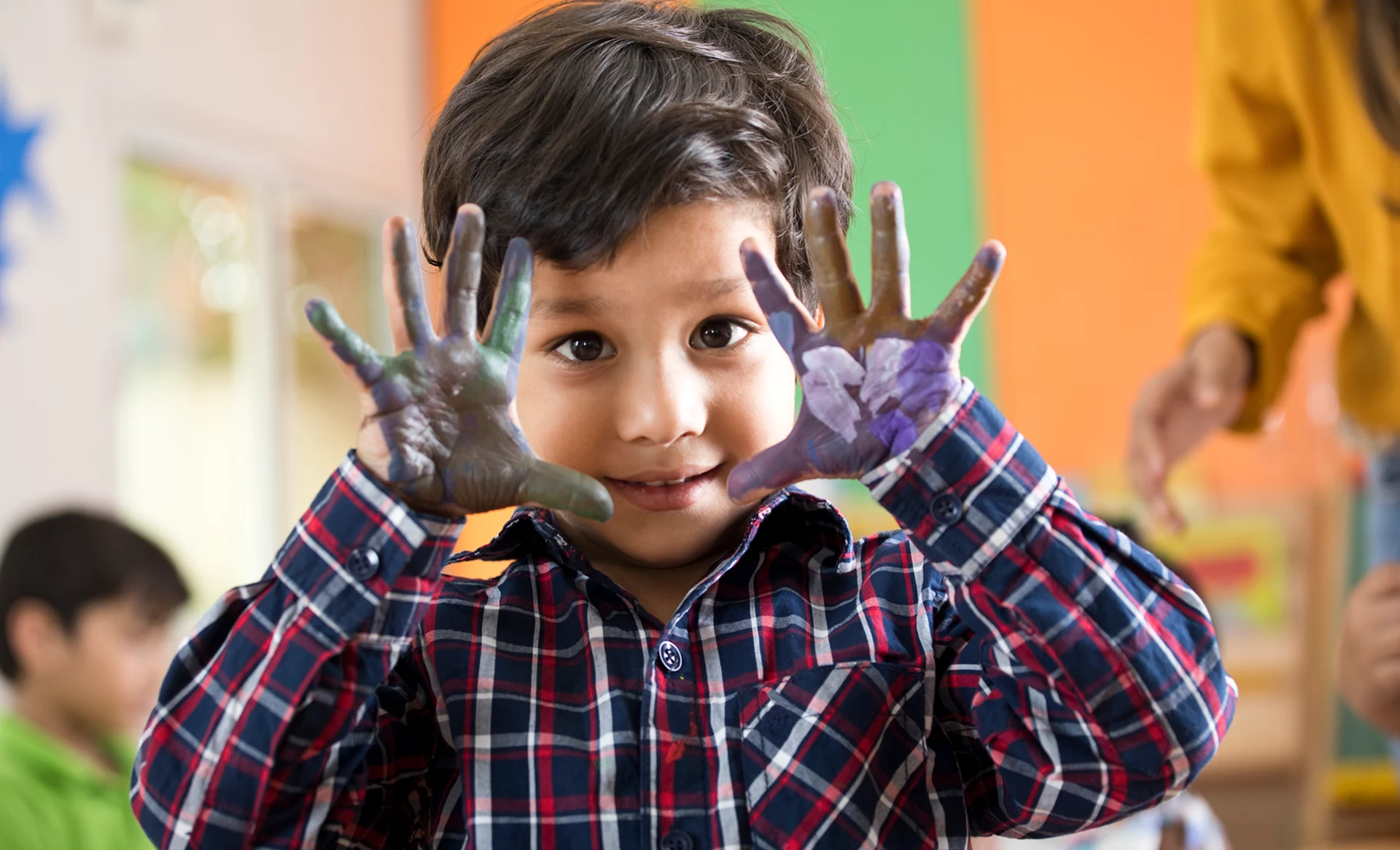
It is a little after nine. A classroom of young children sit in a wide circle on the floor, knees almost touching. The teacher sits on the floor too, part of the circle rather than a leader. A child shares, in a mix of two languages, that her grandmother came to stay last night. No one hurries her. A child who is not ready to speak simply passes, and that is accepted too.
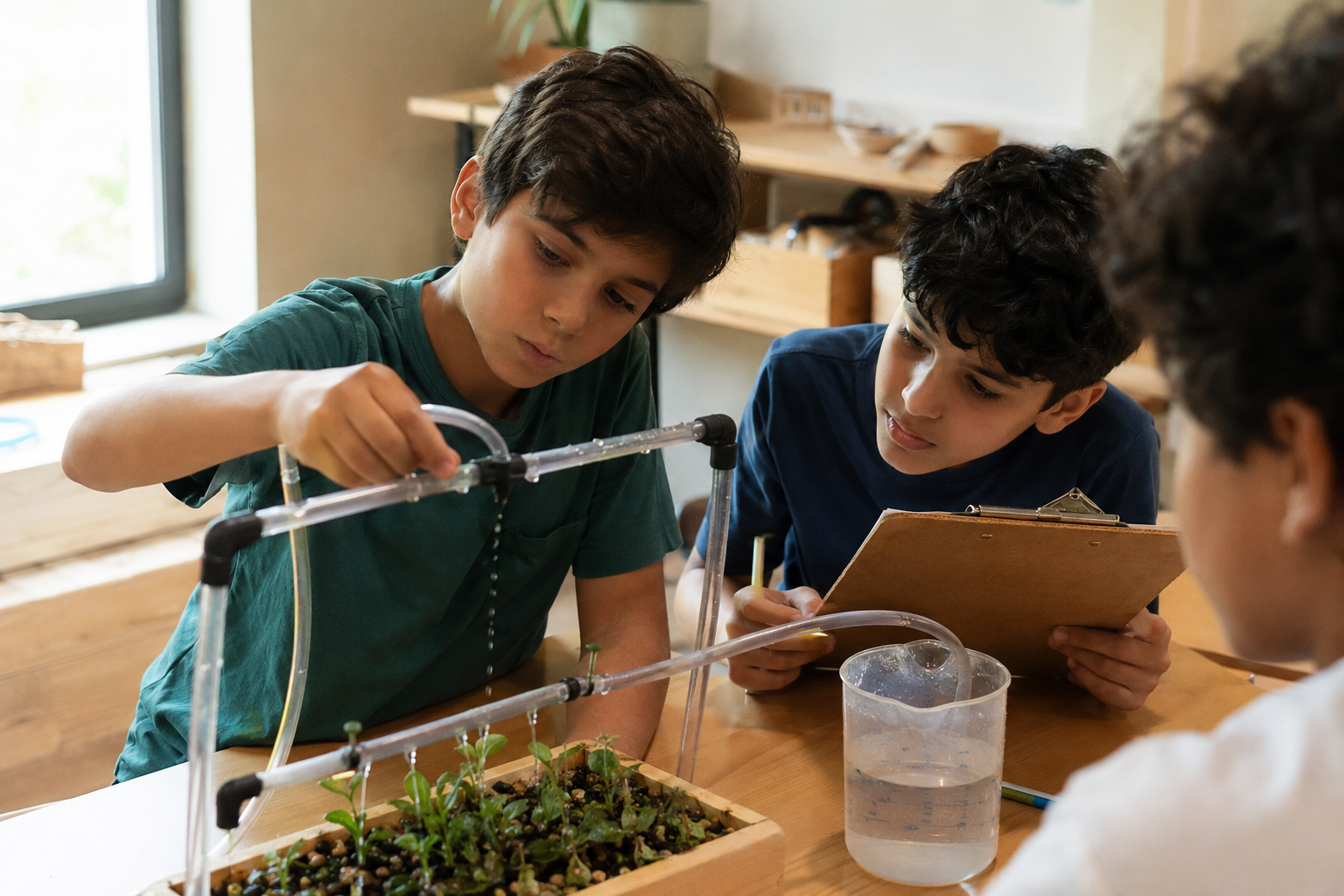
An hour later the same room looks completely different. Three children are at a water tray, absorbed in a question they have not yet put into words: how does water flow, and can we make it go somewhere else? Nearby, a block tower has become ‘the tallest building in Gurgaon’ and its builders are arguing, productively, about what it needs to stay steady.
The teacher has watched, documented, and made a note. She is not waiting for the play to end so the learning can begin. For a young child, the play is the learning.
What the research tells us
The early years, ages three to seven, are not a rehearsal for real school. They are a stage of development with their own dignity and their own urgency. During this window the brain grows rapidly across every domain at once: physical, cognitive, social, and emotional. The quality of a child’s experiences and relationships in these years literally shapes the architecture of the developing brain, laying the foundation for learning for years to come.
Children arrive in school already capable. Piaget showed us that children learn through experience; Vygotsky showed us that they learn through social interaction. The consensus across both traditions is the same: young children are not passive recipients of knowledge but active builders of it.
Play is the engine of this learning. We deliberately speak of learning through play rather than play-based learning, because the second phrase has become so overused it can mean little more than a pleasant activity bolted on after the serious work is done. We mean something more demanding: that play is the primary and authentic way young children explore, grow, and learn. It is an effective driver of executive function, the attention, working memory, and self-control that underpin all later learning. When children take on pretend roles, build and rebuild, negotiate rules with a friend, or test a theory about why something sinks, they are not taking a break from learning. They are doing the work of learning.
Structure and meaning are not opposites
It would be a mistake to romanticise play to the point of abandoning structure. Young children deserve both: the worthy effort of mastering something and the joy of wondering freely.
Montessori understood the cognitive architecture of learning: structured progression, concrete experience before abstract idea, and the reward of real concentration. Reggio Emilia understood that learning is social, expressive, and deeply human. The science of learning adds what neither could fully articulate: that understanding endures when prior knowledge is built upon deliberately and when foundational skills are scaffolded with care.
This is why a Vasant Valley day holds open-ended inquiry and dedicated, well-taught foundations of literacy and numeracy, and treats them as complementary, not competing.
What this looks like
Our early years classrooms are designed as carefully as any lesson plan, because the physical space carries a message to the child about who holds power and whether this is a place where they belong.
There is no teacher’s desk. Shelving is low and at eye level. Materials are within reach so children can fetch what they need without asking permission. Every room holds a quiet corner where a child can take themselves to manage big feelings and self-regulate. Books live in the classroom itself, woven through the day rather than scheduled into a distant library lesson.
Beyond the classroom, this philosophy extends into our early years spaces: the outdoor playground at Jhoola Badi, the garden at Vasant Bagh, the mud kitchen at Vasant Rasoi, and the maker space and light and shadow ateliers, each offering a different kind of learning.
The day moves deliberately between coming together and branching out. Morning circle anchors the class as a community. Guided play follows, led by the child’s questions. Literacy and numeracy blocks run through the day. And free play, ample, uninterrupted, chosen, happens every single day without exception.
How we know children are learning
If learning is constructed and expressed in many different ways, we cannot assess it with a single checklist. A checklist tells us some of what a child can do but almost nothing about how they think, theorise, persist, or collaborate.
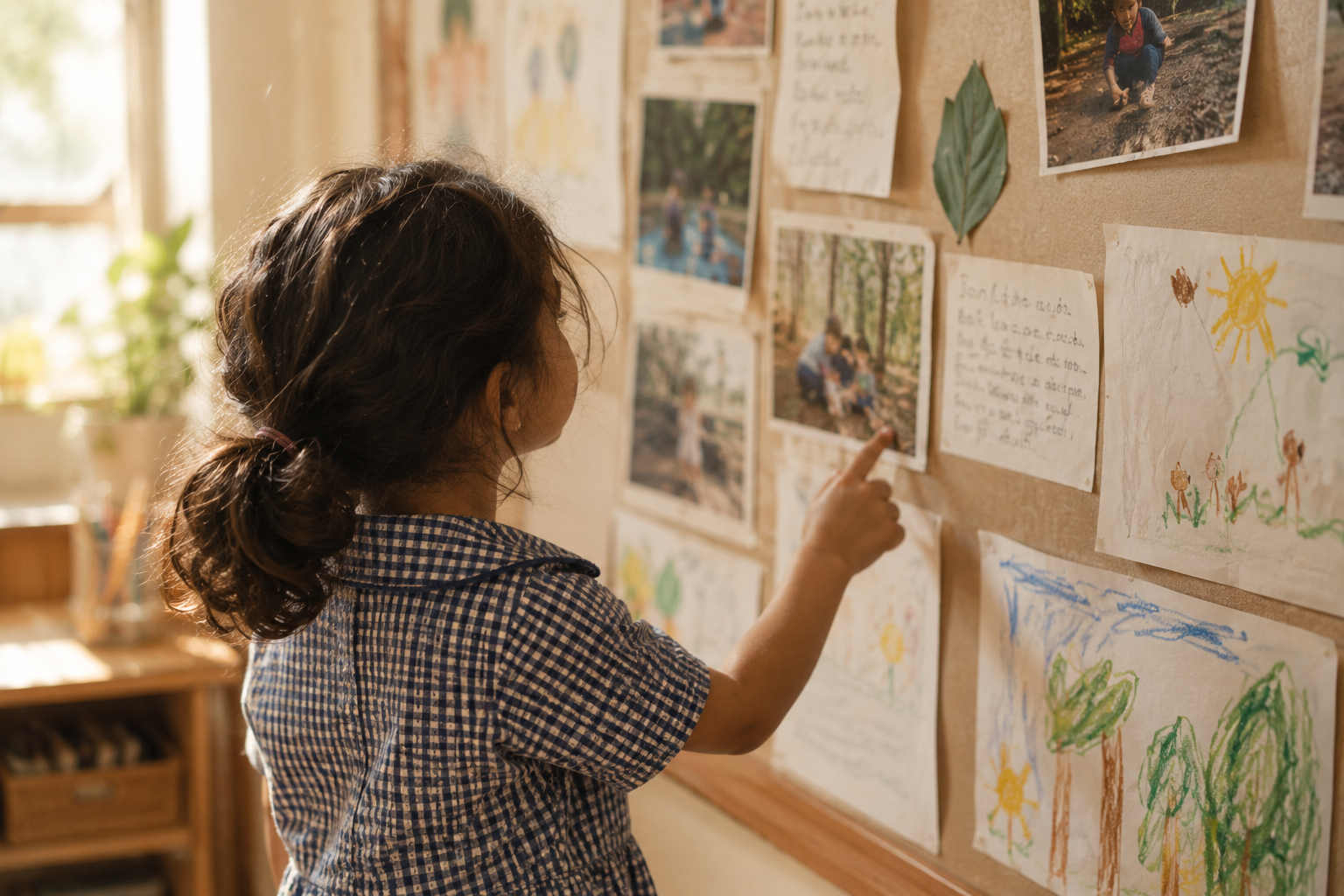
Assessment in our early years builds a rich picture of each child through documentation and learning stories: photographs, drawings, observations, and the child’s own words. Teachers document not only what a child has learned but how they came to understand it. This is what Reggio Emilia calls making learning visible, turning the often-invisible process of thinking into something a child, a family, and a teacher can look at together. Documentation is not a record made after the fact. It is part of the teaching itself, because it is how we decide what to next offer a child.
Families are partners in this from day one, not as spectators but as collaborators.
The early years are where the architecture of a person is first laid down: the habits of curiosity, the capacity for connection, the confidence to try something hard and come back from it. We treat that responsibility seriously, because what happens in these years matters, and because every child who walks through our door deserves to be met with exactly that understanding.