
“The best way to predict the future is to invent it.” — Alan Kay
An Ordinary Room full of Extraordinary minds
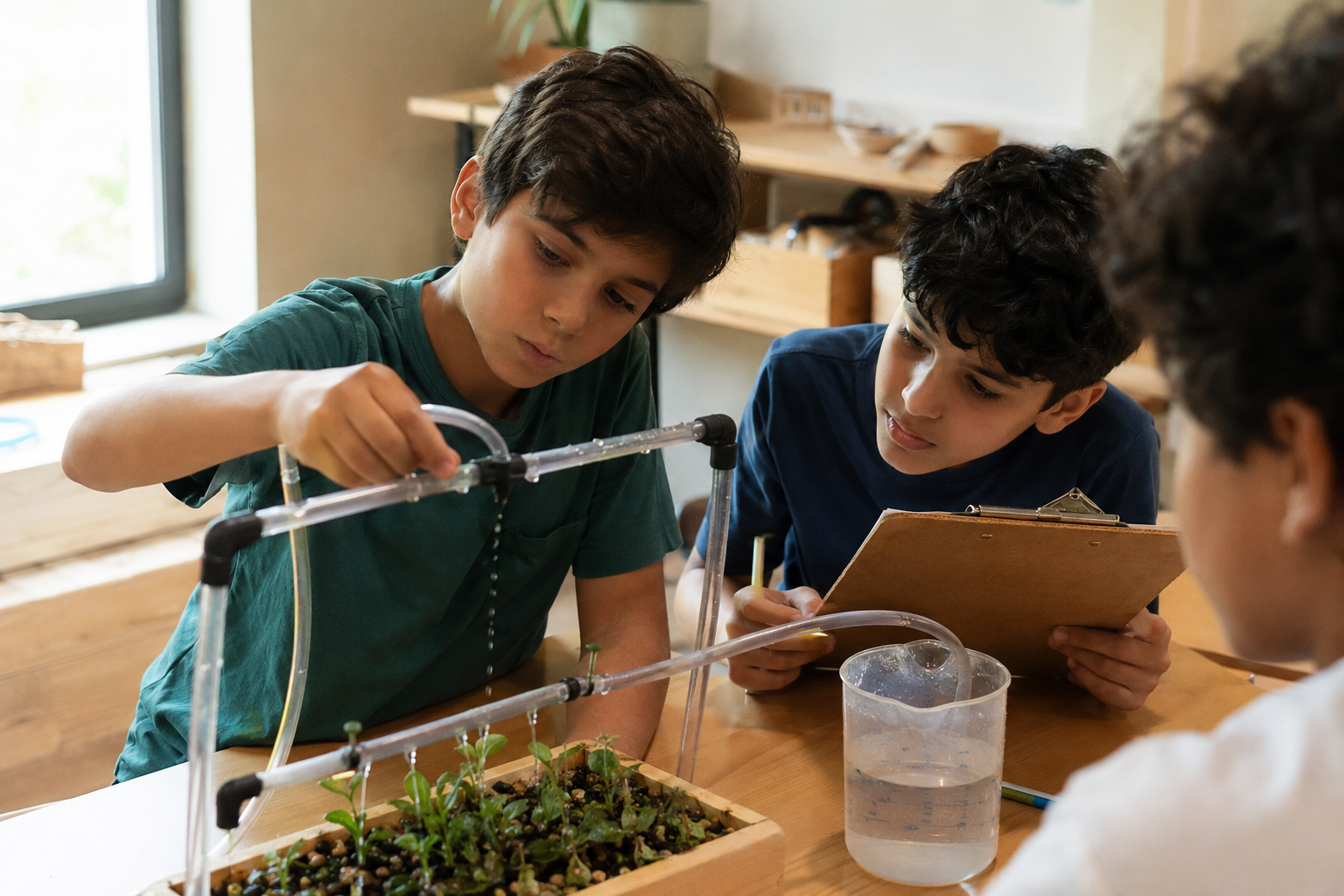
On a particular day, in a busy room young creators are found mid-thought, their hands busy before their sentences have caught up. The scrape of cardboard against a cutting mat. A motor tested, rotating the wrong way, adjusted, tested again. Someone asking a friend to hold a wire steady for one more second.
The children in that room are working on their greatest inventions, ideas meant to make life easier, not only for themselves but for the people they love. A Gym Buddy Bot that can walk and run at different speeds for a beloved grandparent or a comforting night-light plushie for a sibling afraid of the dark. Their materials are wonderfully ordinary: used boxes, old clothes, batteries, wires, small bulbs, motors, and wheels salvaged from discarded gizmos. However, their blueprints are anything but ordinary.
A Question We Don’t Usually Ask
On 15th of September, National Engineer’s Day, we celebrate the life and legacy of Sir M. Visvesvaraya, one of India’s most distinguished engineers, whose work in water management and irrigation, including his association with the Krishna Raja Sagara Dam on the Cauvery River, left a lasting mark on India’s infrastructure.
But there is a question worth pausing over: When does an engineer’s journey really begin?
Does it begin when they choose the “right” subjects at school? Or much earlier, in those first moments of tinkering, taking something apart simply to see how it works, trying to make it work differently, or designing something because a problem in front of them demands a solution? Perhaps the children described above are not merely practising engineering or getting an early preview of it. Perhaps they are already inside it.
Engineering Unlocked: Block by Block
Research suggests that these instincts emerge remarkably early. Bagiati and Evangelou (2016) observed eighteen children between the ages of three and five over four months, examining their behaviour during free block play. The children built towers, enclosures, bridges, roads and pathways. Across these constructions, researchers observed goal-setting, problem-solving, combining ideas, testing designs and modifying them in response to what happened. None had been formally taught an engineering design process. They were simply depicting one, block-by-block.
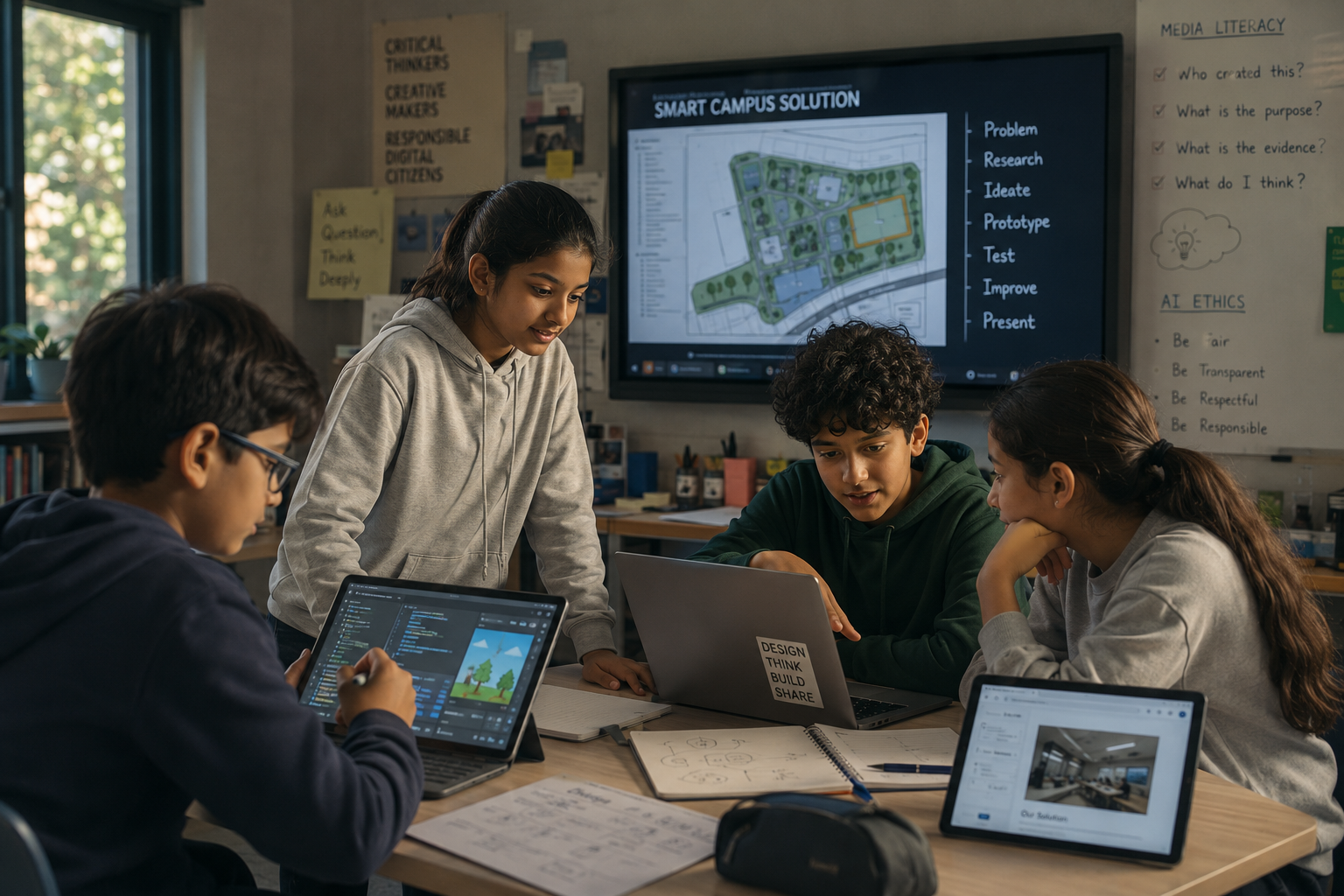
At Vasant Valley School, Gurgaon Campus, these instincts are given room to grow through design thinking, Maker Engineering and experiences that invite children to pose open-ended problems, build, test and rethink. A child might notice that the campus could do more to welcome its smallest inhabitants and ask, “How could we make this space better for birds and insects?” One might design a bird-watering station, another an insect hotel, another a shaded shelter or a way to collect rainwater for plants. In the process, they begin to think like civil engineers, understanding a space, identifying a need, working with materials and designing structures that respond to the environment.
Why Failure Is Not the Opposite of Progress
The process of building isn’t a linear one. Focusing our attention back onto the ordinary room above, inevitably, something doesn’t go as planned. A wire slips loose, a motor spins the wrong way or a plushie’s stitching comes undone. Nobody in the room treats this as an ending. A line from a famous children’s book, Rosie Revere, Engineer by Andrea Beaty, one we often return to puts it better: “Your brilliant first flop was a raging success, come on, let’s get busy and on to the next.” Failure, in making, is rarely the opposite of success.
This is where the idea of antifragility becomes useful, not as a buzzword but as an accurate description of what’s happening in that room. Nassim Nicholas Taleb’s framework distinguishes between the fragile, which breaks under stress, the robust, which merely withstands it, and the antifragile, which actually grows stronger because of it. Engineering, practiced honestly, sits in that third category. A design that doesn’t hold isn’t a dead end, it’s the information the next attempt needs.
That same loop, attempt, adjust, attempt again, is also what makes a child, “Future Fluent™”. Not fluent in any single tool or technology, since those will keep changing shape faster than any curriculum can track, but fluent in approaching an unfamiliar problem without a manual for it. If this is the habit we want children to carry forward, then the question becomes: how might learning itself make room for this way of thinking?
Concept to Creation
This way of thinking sits at the heart of how learning is approached at Vasant Valley School, Gurgaon Campus. Across learning experiences, we aim for a 2:1 relationship between concept and creation: for every two parts of a concept a child encounters, there is space to spend one part actively making, applying or experimenting with it.
The ratio is not a formula, nor is it about counting minutes; it is about giving children the opportunity to put concepts to work. Take a simple question: “What helps me focus?” For one child, it may be soothing sounds and hence they create a rainstick made from cardboard rolls and grains. For another, it’s keeping their hands busy so a slime or squishy toy is created. Someone else may focus better with movement and create a fidget spinner, while another may prefer visual cues and design a colour-changing focus timer. The problem is shared, but the solutions are personal, drawing on concepts of sound, materials, movement, light and design to create something that works for them.
Bringing Creation Home
This idea travels well beyond any classroom or campus. A parent can cultivate the habit of mind: for every conversation about how something works, whether it’s a fan, a bridge passed on a drive, or a recipe on the stove, there could be an attempt to take it apart, rebuild it, or make a prototype of it out of whatever is lying around the house. The adult’s role is less to provide the answers and more to notice the child’s curiosity, ask the next question, and create the environment and provide the materials in which an idea can be explored. Parental involvement matters here more than what is generally assumed; a study on parent-involved early engineering education found that when caregivers took part not as experts correcting the work but as co-builders and fellow inquirers, children’s engineering learning outcomes measurably improved (Ata-Akturk & Demircan, 2021).
So this National Engineer’s Day, perhaps we should celebrate more than the dams, bridges, machines and systems that engineers have built. Perhaps we should also notice the child taking apart a broken toy, rebuilding a cardboard structure, changing a design after it collapses, or insisting that their robot should move this way instead of that. These moments can look ordinary. But perhaps they are not. Perhaps the child is already practising the habits of mind that engineering asks of us: to notice a problem, imagine a possibility, make something, learn from what happens, and try again.
The blueprint was always there. We only need to recognise it.
References
Ata-Akturk, A., & Demircan, H. O. (2021). Supporting preschool children’s STEM learning with parent-involved early engineering education. Early Childhood Education Journal, 49(4), 607–621. https://doi.org/10.1007/s10643-020-01100-1
Bagiati, A., & Evangelou, D. (2016). Practicing engineering while building with blocks: Identifying engineering thinking. European Early Childhood Education Research Journal, 24(1), 67–85. https://doi.org/10.1080/1350293X.2015.1120521
Beaty, A. (2013). Rosie Revere, engineer (D. Roberts, Illus.). Abrams Books for Young Readers.
International Technology and Engineering Educators Association. (2020). Standards for technological and engineering literacy. https://www.iteea.org/
Taleb, N. N. (2012). Antifragile: Things that gain from disorder. Random House.