

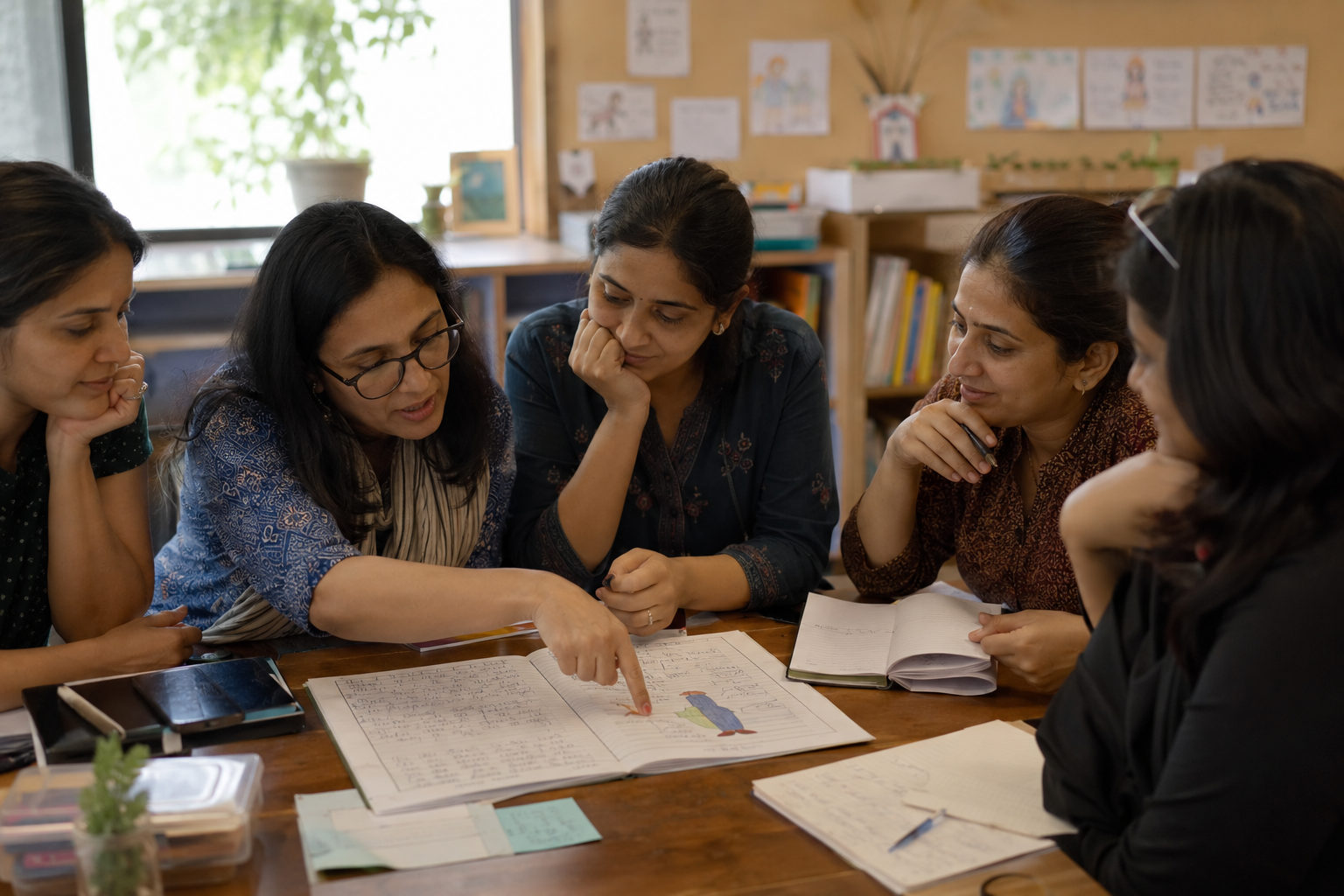
On a weekday afternoon, a small group of teachers gather around a table. Not for a briefing. Not for announcements. They have brought samples of student writing — the same piece of writing, from each of their classes — and their question is precise: where exactly are our young writers getting stuck, and what will we, together, do about it?
One teacher notices that several children across all three classes lose their thread in the middle of a paragraph. Another has tried a strategy that seems to help and offers to model it. By the time the children arrive the next day, the team has agreed on one change each of them will try, and on how they will know, two weeks from now, whether it worked.
This is a Professional Learning Community at work. It is not a meeting that happens to teachers. It is the ordinary, recurring way our teachers study their own practice so that every child in every class learns more.
Our starting position
A child learns most in a classroom led by a teacher who is herself still learning, still curious about what is and is not working, still refining her craft alongside colleagues.
We hold a simple conviction: student learning and teacher learning are the same project, seen from two sides. The quality of learning a child experiences is shaped not only by how skilled their individual teacher is, but by how well our teachers learn together.
As researchers Newmann and Wehlage observed, schools can be full of competent individual teachers and still lack the organisational capacity to serve many children well. The task is to build an effective collective — not to improve one teacher at a time behind a closed door.
What the research tells us
The most widely cited framework comes from Richard DuFour and colleagues, whose definition is clarifying: a Professional Learning Community is an ongoing process in which educators work collaboratively in recurring cycles of collective inquiry and action research to achieve better results for the students they serve. The key word is ongoing. A PLC is not an event on a timetable. It is a way of working that, done well, changes the culture of a school.
DuFour’s model organises a team’s work around four deceptively simple questions: What do we want all students to learn? How will we know when each student has learned it? How will we respond when a student has not yet learned it? And how will we respond when a student already has? Holding these four questions steady keeps a team focused on learning rather than merely on teaching, and on what the adults can do better together rather than on what students should have done differently.
In John Hattie’s synthesis of educational research, collective teacher efficacy — the shared belief among a staff that, working together, they can lift the achievement of every child — emerges with an effect size of 1.57. To put that in context, researchers generally treat 0.4 as the point at which an influence is worth taking seriously. An effect size of 0.40 generally equals one typical year of student learning growth for one year in school. When teachers believe in their joint capacity and act on it, children benefit. The research here is clear.
What a PLC is — and what it is not
Because the term is used loosely in education, it is worth being plain about a few common misconceptions.
It is not simply a meeting. A PLC is a continuous way of working. If teachers meet and then return to business as usual, they are not yet functioning as a PLC.
When a team concludes only that students need to try harder, it has the wrong focus. The PLC question is always what we, as educators, can do better together.
And it is not collecting data for its own sake. Unless analysis of evidence leads to higher levels of student learning, as DuFour puts it bluntly, we are not doing data right.
How this fits into how our teachers keep learning
PLCs are one strand of a deliberately designed system, not the whole of it.
Our teachers also work with instructional coaches — in non-evaluative conversations that help a teacher set a clear goal, gather honest evidence about their own classroom, and refine their practice toward that goal. They engage in spiralling learning modules, so that new ideas build over time rather than arriving as one-off workshops. They pursue teacher-directed professional development in areas they have chosen themselves. And they work with external specialists in particular curriculum areas, who visit the school to work directly with them.
These approaches reinforce one another. A coaching conversation may surface a question that a PLC then takes up as a team. A course may introduce an idea that a specialist later helps the whole staff put into practice. Together they express a single belief: a school that asks children to be lifelong learners must model exactly that in its teachers.
What makes our PLCs actually work
We hold our PLCs to a clear set of conditions, and these are the commitments we make to families.
Each team works on a genuine, well-defined problem of practice. Sessions have a clear focus and a clear process rather than being open-ended. Teams work in defined cycles with protected time, so that enquiry has rhythm and does not dissolve into the busyness of term. We invest in skilled facilitation and a culture of trust, where teachers can open their practice to colleagues, disagree productively, and learn from one another. And each team is accountable for acting on what it learns — committing to specific changes they will try, and measuring whether those changes helped children.
Above all, we assess the effect of our PLCs where it ultimately matters: in student learning in classrooms.
We share this with families because the work of our teachers belongs, in the end, to your children. When you see your child’s teacher in a planning meeting or a coaching conversation, you are seeing the same conviction that animates our classrooms: that with high expectations and the right support, everyone can keep growing.
The investment we make in our teachers’ learning is, quite directly, an investment in your child’s.