
On a heavy monsoon morning, a girl pressed her face to the classroom window and asked that question out loud. The road outside school was flooded. The lane behind it was almost dry. One friend said the road must be lower. Another was sure the drains were blocked. A third thought the water had run down from the park.
Within minutes, three children were doing what scientists do: noticing a puzzle, offering explanations, and arguing about evidence.
That question — why does the water always come to our road? — became the beginning of eight weeks of real science.
Our position on science education
Science at our school is a way of thinking before it is a body of facts. Five principles shape every science learning expedition we design.
- Inquiry is central to understanding. Children construct and challenge their ideas by combining scientific knowledge with reasoning, evidence, and investigation — not by receiving answers.
- Concepts and skills lead the curriculum. Knowledge is built in depth around big ideas that transfer across subjects and into new situations.
- Learning is active and real. Through learning expeditions, fieldwork, and work with experts, children investigate genuine questions as scientists, historians, and engineers do.
- Deep learning is the expectation. We define achievement as mastery of knowledge and skills, strength of character, and high-quality work shared with authentic audiences.
- Science builds habits of mind. Children learn to question, persist, weigh evidence, make informed and responsible decisions, and act on what they understand.
From topics to concepts
Most school science teaches topics — the rainforest, the water cycle, the Indus Valley. Children learn, recall, and move on.
At Vasant Valley, topics are the entry point. The concept is the destination. A concept is a big idea that lies beneath many topics — open-ended, transferable, and impossible to exhaust. The question Why does the water always come to our road? opened into two concepts the class would use all term: erosion and settlement.
| Topic | Subject concept | Cross-cutting concept | How it looks in other subjects |
| Water and the land | Erosion | Change | Mathematics: rainfall graph; Language: character change; PSL: bodies change with food/sleep/exercise; Arts: dance slow to fast |
| The Indus Valley Civilisation | Civilisation | Interdependence | Science: food chain; Mathematics: balance scale; PSL: team where every role matters; Arts: ensemble |
| Drainage | Flow | Systems | Science: digestive system; Mathematics: place value; Language: grammar; Arts: taal in Indian music |
Topics give children knowledge. Concepts help them use it — in this unit, in the next, and in situations no teacher has planned for.
How we teach it: experiential learning
Science at Vasant Valley unfolds as a learning expedition — a long, in-depth study built around a guiding question. This expedition asked: How does access to water decide where people can survive and flourish?
Each stage builds on the last.
| Stage | What happened |
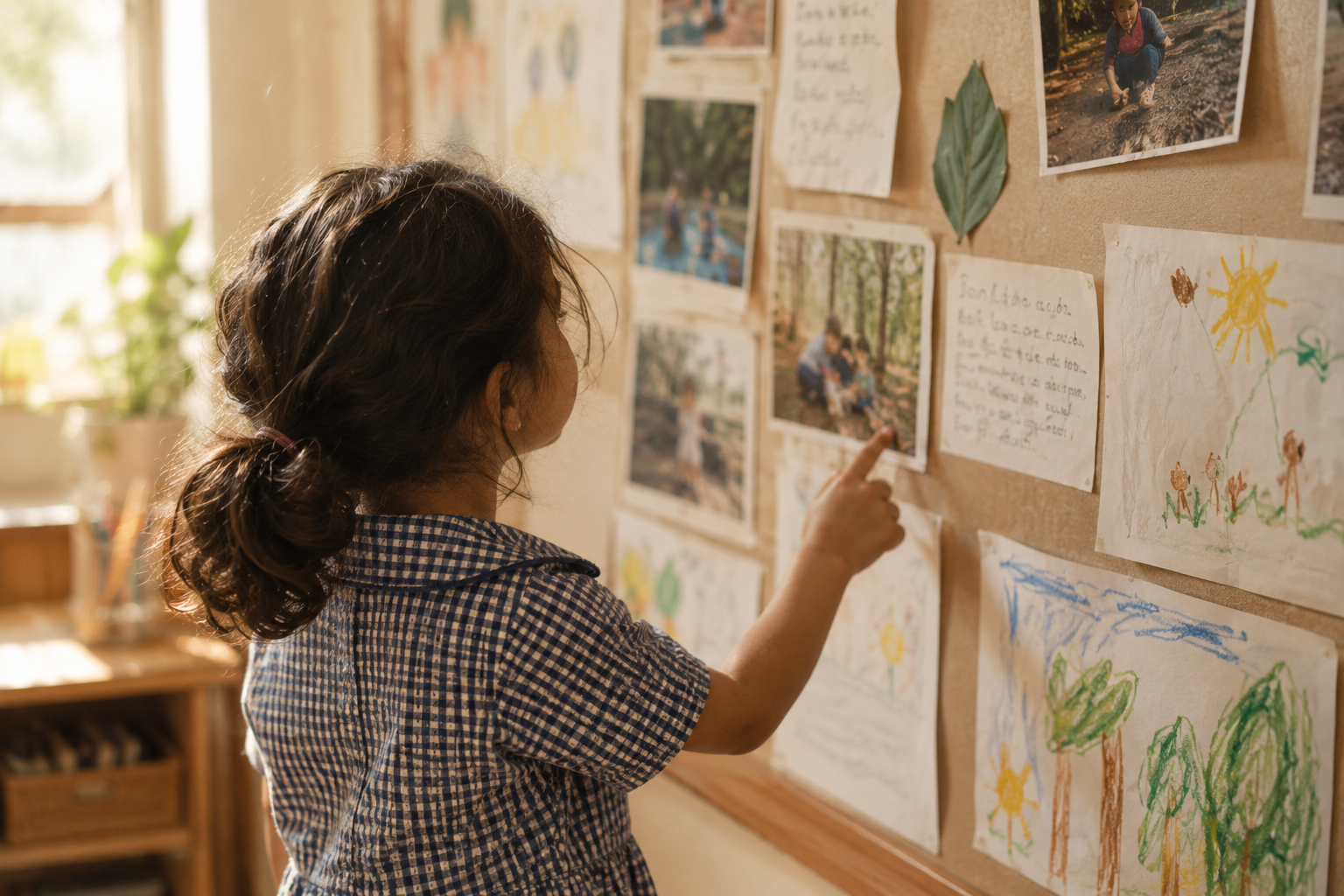
| Kickoff | Children study a world map of ancient cities — all clustered beside rivers. The wall fills with questions. Several children link the map straight back to the flooded road outside school. |
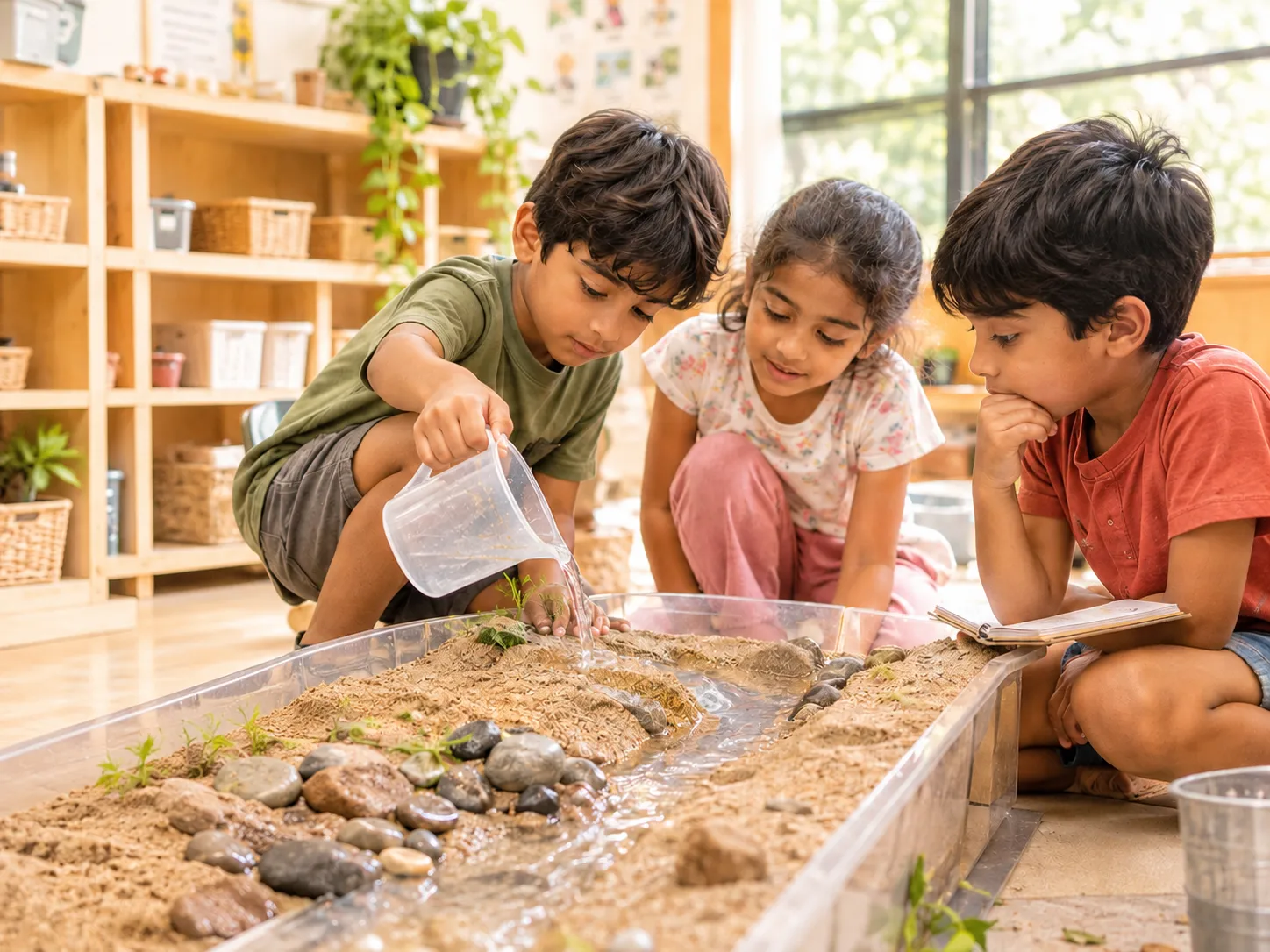
| Case study 1 | Stream table investigations. Children design fair tests, measure soil movement in centimetres, and plot results. “In every test the water ran to the lowest point — so houses on high ground are safer.” |
| Case study 2 | Dholavira, a Harappan city in Kachchh with no perennial river, built at least 16 reservoirs 4,500 years ago. Children notice: Dholavira’s drains did exactly what their road needs to do. Where nature gave less, people engineered more. |
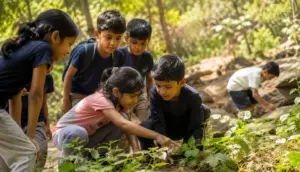
| Fieldwork | At Agrasen ki Baoli in Delhi, children sketch the stepwell as investigators — reasoning about why a well needs stairs when the water falls in summer. |
| Experts | A water engineer visits, answers their questions, and gives feedback on their early designs. |
| Service | Children map where water collects outside school, measure depth, and propose a planted strip. Findings sent to the estates team and the local resident welfare association. |
| Culminating event | Teams present to families, teachers, and the expert panel — showing every version of their design, the evidence behind each change, and the class proposal for the road. |
This kind of learning builds more than science knowledge. Children think critically and creatively, research independently, communicate their reasoning, work with others, and manage their own time and effort. Educators call this ‘learning agility’ — knowing how to proceed when the answer is still unknown or the situation is unfamiliar.
Concept to creation: the design challenge
This is where understanding becomes design — and where all five principles converge.
The brief
Design a settlement beside a river that gives its people water and keeps them safe from floods and erosion. Written by real engineers. Given to children.
The build
- Each team designs a model landscape — a river, high and low ground, homes, farms, a well
- Teams decide how to protect the soil: barriers, channels, grass
- Teachers pour in a measured “monsoon”
The test
- A wall that saves the houses sends water into the farm
- A farm beside the river has easy water — and floods first
- Every failure is treated as evidence
The revision cycle
Why did that happen? → What will we change? → What do we predict now?
Teams revise, give each other feedback, and test again.
The pitch
Teams present to a panel — a civil engineer, a historian, and a water management specialist — who ask the questions professionals ask. Would this wall hold in a bigger flood? Where would your drinking water come from in a dry year? Teams record the feedback and refine their models.
This is concept-to-creation: not a craft activity at the end of a unit, but proof that understanding has happened. A child who can design a settlement that survives a flood, explain every decision to an engineer, and propose a real solution for their own road has moved from knowledge to wisdom.
Learning that crosses every subject
One question. Eight weeks. Every subject involved.
| Subject | What children did |
| Science | Tested how moving water wears away land; designed fair experiments at the stream table |
| Mathematics | Measured soil movement, read Gurgaon’s rainfall graph, spotted patterns |
| History | Treated excavated reservoirs as evidence; traced water storage from Dholavira to Delhi’s baolis |
| Geography | Mapped high and low ground; compared Kachchh with the Indus valleys; found where monsoon water collects nearby |
| Language | Used precise vocabulary; wrote explanations linking cause and effect; argued from evidence |
| The arts | Drew the baoli; painted a river in flood; performed a village council scene; composed a monsoon soundscape with Raag Malhar |
| Personal and social learning | Weighed easy water access against safety; listened before deciding |
Each subject developed its own concepts and skills. The shared question brought them together.
What families can do at home
Children’s interest in science depends significantly on how visible science is at home — researchers call this science capital. You don’t need a science degree. You need a few habits.
Ask what they noticed, not what they learned. “What surprised you?” and “What would you change?” go further than “What did you do today?”
Ask three kinds of questions.
- Factual: Where did the water go?
- Conceptual: Why does water always run downhill?
- Debatable: Should every building have to store its own rainwater?
The last two stretch thinking furthest.
Follow the water. Find out where your tap water comes from, where rain goes on your street. Visit a stepwell, a lake, or a riverbank and let your child lead the questions.
Treat a surprise as a puzzle. When something unexpected happens — a puddle, a wilting plant, a sound they can’t explain — ask “Why do you think that happened?” and wait. A guess a child tests teaches more than an answer you give.
The road outside school still floods on some monsoon mornings. Now the children know exactly why — and they have a proposal to share. When your child comes home asking why the water always comes to your road, you will know the science is working.