

“We don’t learn from experience.
We learn from reflecting on it.”
— John Dewey
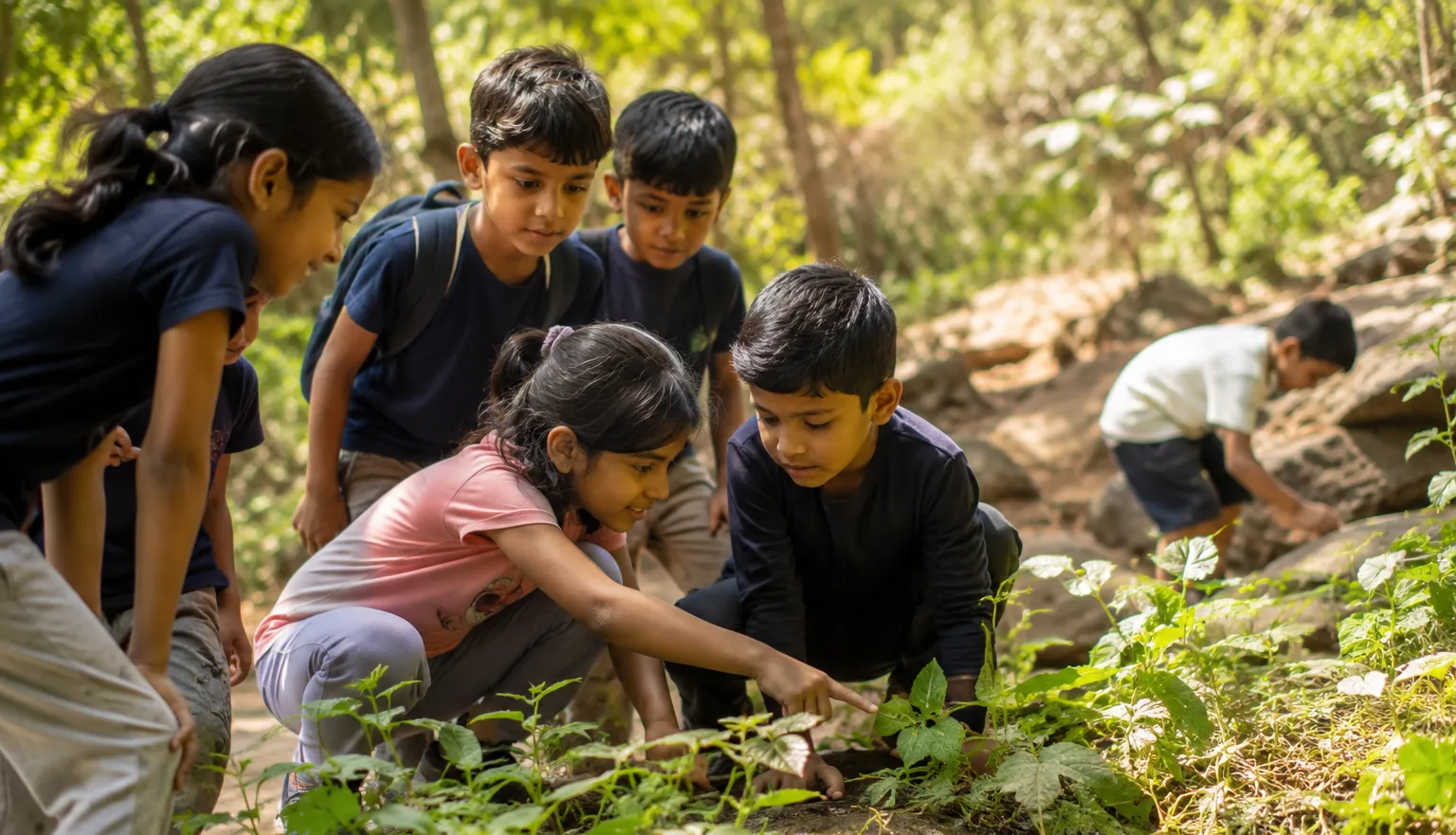
One morning, a Class 2 boy walking past the potted curry leaf plant near our entrance spotted a Common Myna pecking at something under a leaf. It was a caterpillar. He called two classmates over, and the questions that followed lingered inside the classroom long after morning assembly had ended.
The children talked it through with their teachers and decided to rear butterflies and create a butterfly garden. Their guiding question: what conditions does a butterfly species need to survive?
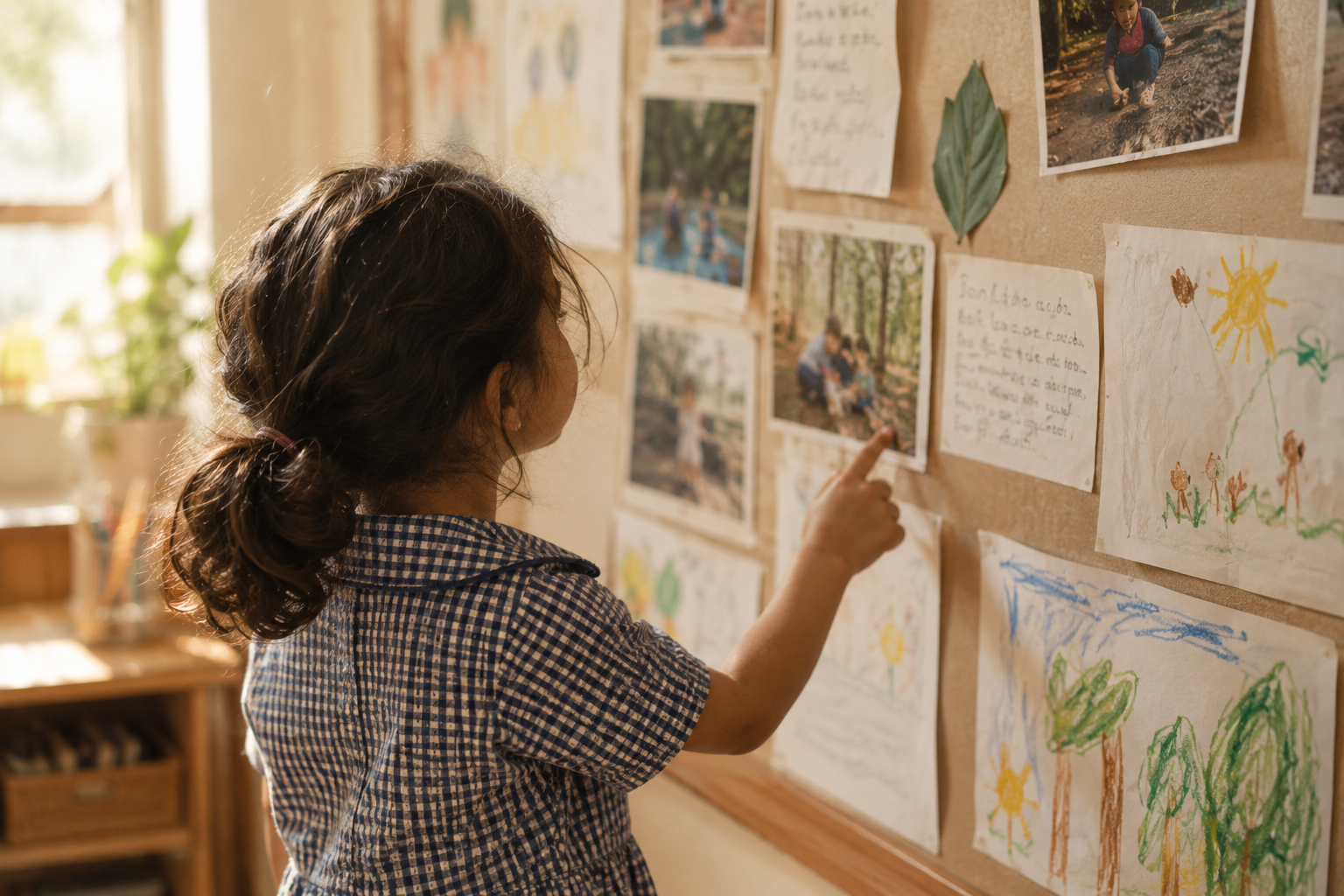
What followed was not a project unit added to the curriculum. It was the curriculum. The children researched at home and at school, reared caterpillars in a mesh enclosure, and recorded every stage from egg to larva to pupa to adult in field journals — with dates, sketches, and questions in the margins. Naturalists who worked alongside them called their caterpillar records the most careful larval observation they had seen from children this age. The children revised their planting plan after expert critique, made compost from the school’s kitchen waste, and visited a community butterfly garden to understand how one is properly made.
A caterpillar on a leaf became weeks of biology, ecology, research, writing, and genuine craftsmanship.
Our starting position
At Vasant Valley School, DLF City Campus, we believe experience is where understanding begins. Real work teaches children the value of effort, research, collaboration, and perseverance, building agency along the way.
But “hands-on” describes an activity. Our position goes further. An experience teaches when it has been chosen with care, guided while it happens, looked at honestly afterwards, and given a real job to do. The caterpillar project worked not because it was enjoyable — though it was — but because teachers planned backwards from the question, built in feedback from experts, and held children to high standards of observation and revision.
As Ron Berger puts it: “When you’re proud of your work, when it’s beautiful, you’re motivated to work harder.” Craftsmanship — the willingness to refine work through multiple drafts and seek critique — is both the method and the outcome.
What the research tells us
John Dewey was clear on this a century ago: “Mere activity does not constitute experience.” An experience teaches when a child can make a connection between what they did and what followed from it. Enjoyment alone is not enough. What matters is what it carries forward.
This is why guided discovery consistently outperforms unassisted discovery. A meta-analysis covering over a hundred studies found that unguided discovery does not produce deep learning, while discovery supported by feedback, scaffolding, and prompts to explain one’s thinking does. The naturalists who critiqued the children’s planting plan, the teachers who gave specific feedback on field journal entries — this is what turned an interesting afternoon into durable understanding.
Complex, product-based work also demands higher-order thinking: applying, analysing, evaluating, and creating — not just recalling. Jal Mehta and Sarah Fine describe this as the shift from receiving knowledge to producing it. That shift is what we are designing for.
What this looks like every day
Experiential learning shows up as consistent habits. Every experience begins with a genuine question. Teaching happens inside the experience — skills and concepts are introduced when children need them. First attempts are never final ones; children revise, seek critique from teachers, peers, and real experts, and then revise again. Reflection is routine: before, during, and after building or investigating, children name what surprised them and what they would try differently. And risk is designed in — intellectual, physical, social, emotional — because a child need not be unafraid to try.
What families can do at home
Let children do real work alongside you. Laying a table, growing vegetables, fixing something broken — these are lessons in being needed and in mattering. They build exactly the agency and persistence that deeper learning requires.
“What did you notice?” and “What would you change?” open doors that a direct explanation closes.
Wait before you rescue. A few minutes of genuine struggle is usually the part where learning happens. And when a child redoes something because it could be better, be deliberate about noticing that.
A child who has done something real, looked at it honestly, and done it again with more care has learned more than we could have told her. That is what we plan for, and what we teach into.