

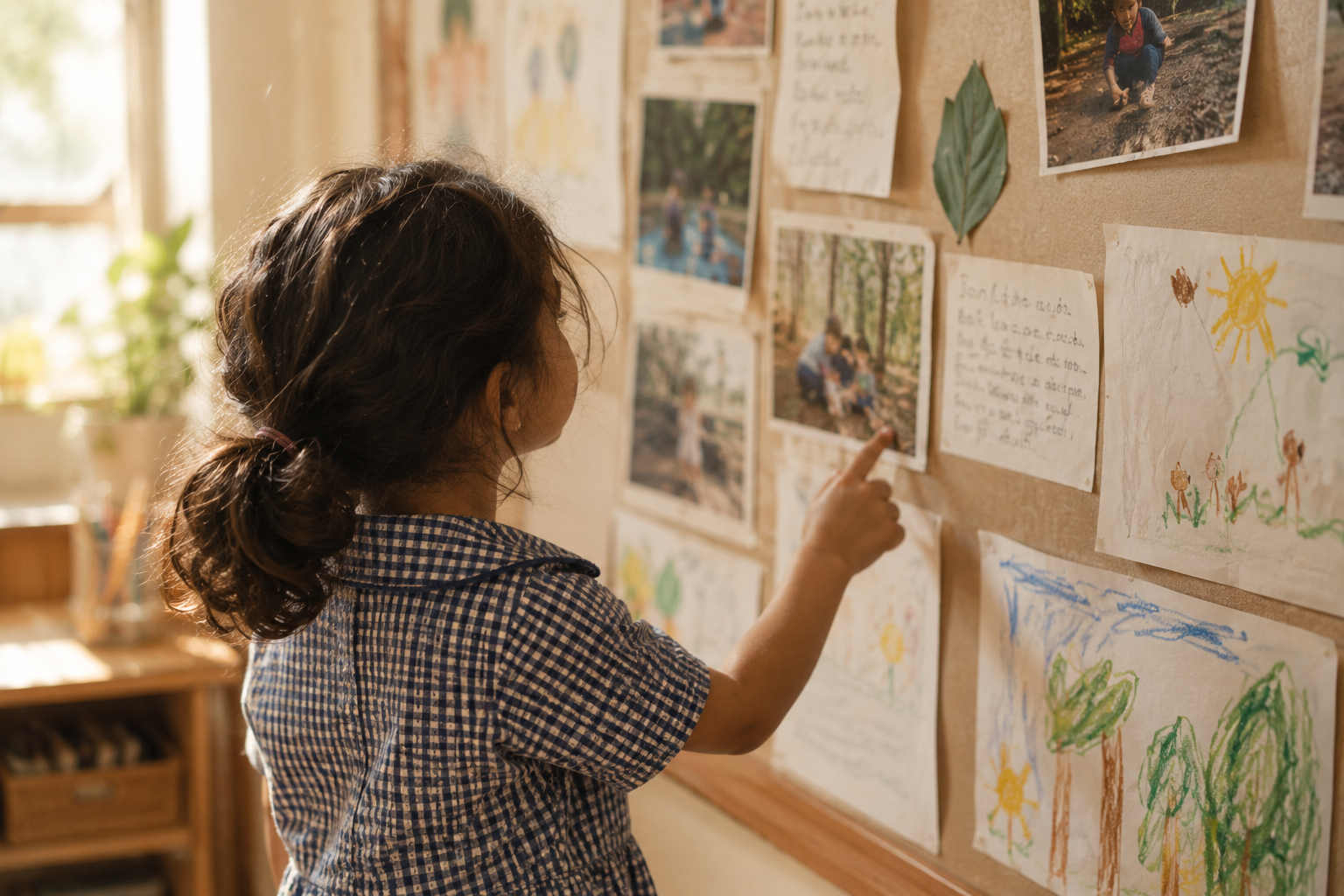
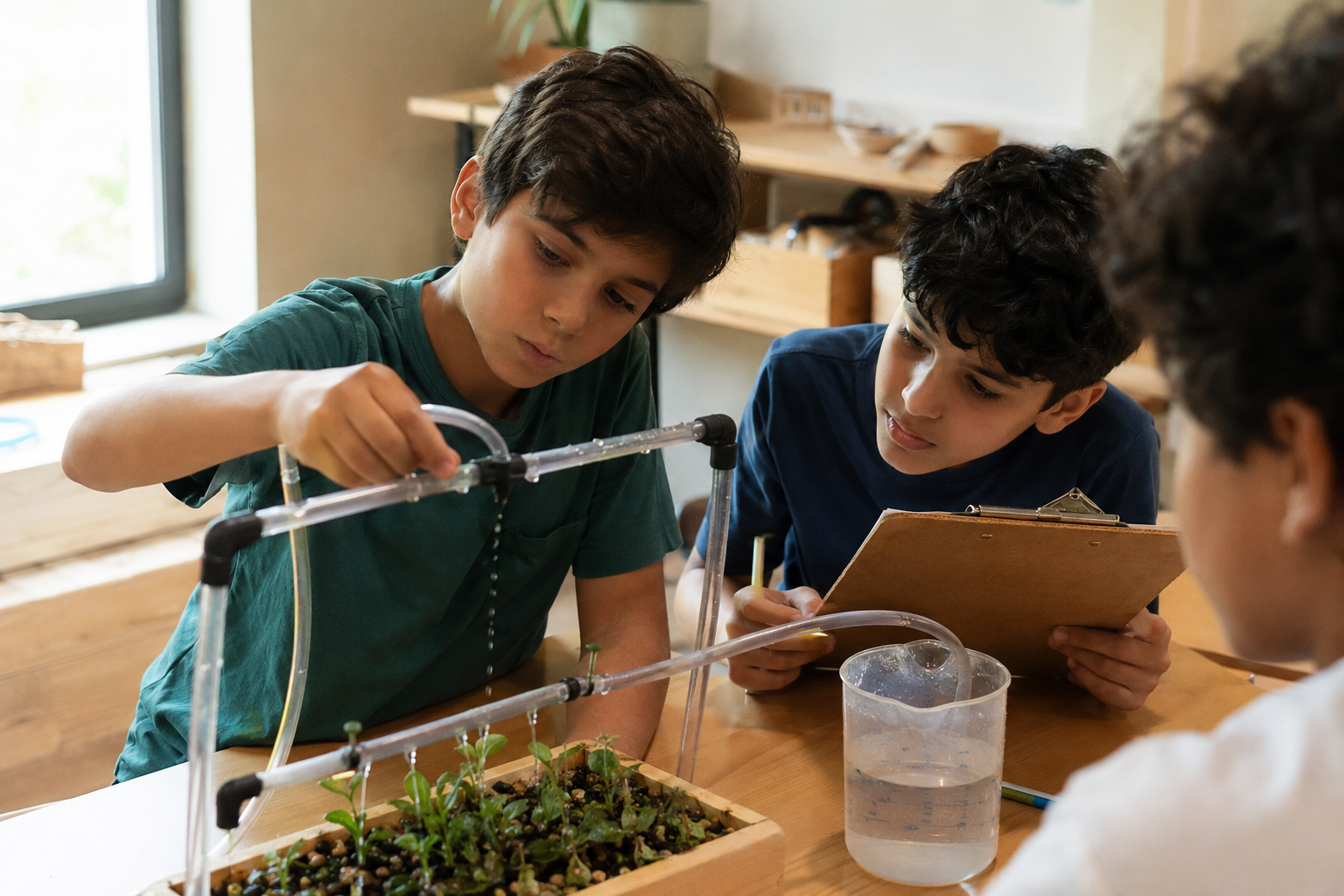
Picture a junior classroom at the start of the day. Students are breaking down the word photosynthesis syllable by syllable, noticing prefixes and roots, not guessing from a picture. Their teacher reads aloud a demanding article about how trees move water from root to leaf, a text that sits above what some children could reach independently and she scaffolds their access to it. She pauses at the hard sentences to think aloud. Afterwards, students write a quick explanation of a water droplet’s journey using words and sentence patterns they met in the reading.
This is what literacy instruction looks like when it is taken seriously. Challenge is the norm, not the exception. Every student is held to a high bar and given exactly the support needed to reach it.
Our starting position
Literacy is the foundation on which the rest of a student’s education is built. India’s National Education Policy 2020 states this plainly: universal foundational literacy and numeracy are the highest priority of the education system, and the rest of schooling becomes largely irrelevant for a student who has not first learned to read, write, and reason with confidence.
We agree. And we take it a step further, drawing on Doug Fisher’s observation that students who rarely confront a difficult task are robbed of the opportunity to cultivate a growth mindset. They become, in his phrase, failure deficient. Students grow as readers and writers by meeting worthwhile difficulty and being supported through it, not by being steered around it.
What the research tells us
Our approach rests on what researchers call the science of reading. The Simple View of Reading (Gough and Hoover, 1990) establishes that comprehension is the product of two things: decoding and language understanding. If either is weak, comprehension suffers. This is why we teach phonics explicitly and early, so students sound words out accurately rather than guess.
But decoding alone is not enough. Skilled reading also requires background knowledge, vocabulary, and the ability to make inferences. These do not develop automatically. They have to be built, deliberately, across every subject. This is why at our school, every teacher is a teacher of language, regardless of what they teach.
Reading and writing draw on overlapping skills. Writing about what one reads deepens comprehension, so we weave the two together. We also teach handwriting deliberately: forming letters fluently frees a child’s mind from the mechanics of writing and allows it to focus on generating and shaping ideas. Research shows that handwriting fluency predicts the quality of what students compose, and that learning letters by hand strengthens the letter recognition that underpins reading (Morin and Montesinos-Gelet, 2012).
We also teach oracy as a discipline in its own right, because speaking and listening can be taught. Students who can articulate ideas and engage through talk are better equipped to make meaning from what they read and to compose what they write.
Finally, National Literacy Trust’s work on AI and literacy makes a point we find clarifying: strong, traditional reading and writing skills are what allow a young person to use generative AI safely and effectively. Students who read and write more engage more critically with AI-generated content. Far from making literacy obsolete, AI raises the stakes for it. The investment we make in foundational literacy is also the surest investment in our students’ fluency with the tools of their future.
What this looks like in practice
A few things follow directly from this evidence.
We do not confine students to restrictive reading levels. Every student reads grade-level texts, with scaffolding. We use assessment to decide the support a student needs, not the ceiling they are allowed to reach. Pre-teaching vocabulary, reading aloud, fluency practice, and targeted support make demanding texts accessible to all.
We protect time for reading for pleasure, and here students’ interests drive choice entirely. A student with a passion for space, pirates, or cricket will read far beyond what a level label would predict. Our task is to keep books, choice, and time abundant so that reading becomes something students do because they love it.
We assess to teach, not to sort. Every student begins with a baseline assessment in reading and writing. Regular formative checks allow teachers to see precisely how each student is progressing and to adapt their teaching accordingly. Families receive insights into their child’s progress through written reports and open days, because parents are partners in this process, not passengers.
And our library is the heartbeat of it all: stocked widely and diversely, with all genres represented, books in multiple languages, and a catalogue designed to offer every student both mirrors reflecting their own lives and windows into lives unlike their own.
What families can do at home
A few simple, evidence-aligned practices at home make a meaningful difference.
Read aloud to your child, long after they can read alone. Hearing rich language exposes children to vocabulary and ideas beyond their own decoding, and this is one of the strongest predictors of comprehension.
Talk about books and the world. Conversation grows language, fosters reading for pleasure, and cultivates imagination.
Let your child choose what they read for pleasure and protect a little quiet reading time each day. Interest is the most powerful reading motivator we know.
Welcome a book that stretches your child. Sit alongside them, help with the hard parts, and let them experience the satisfaction of meeting a challenge.
And be thoughtful about AI. Treat AI tools as something to question and evaluate, not simply to copy from.
Our position can be stated simply. We teach the foundations of reading explicitly and early. We build deep knowledge and vocabulary across every subject. We hold all students to grade-level texts while scaffolding their way to them. We weave reading and writing together, and we make reading for pleasure a daily habit rather than an afterthought.
Given high expectations and the right support, every student can become a skilled, knowledgeable, and joyful reader, writer, and speaker. Difficulty, met well, is not something to protect students from. It is the very thing that helps them grow.